
A few pigeons on a roof edge can quickly become droppings on walkways, blocked gutters, stained siding, and a recurring cleanup problem. When comparing bird spikes vs netting, the right answer depends less on which product looks tougher and more on where birds are landing, roosting, or nesting around your property.
For homes, cabins, vacation rentals, and commercial buildings in mountain communities, bird control has to do more than move birds from one ledge to the next. It should protect the structure, reduce contamination, and discourage repeat activity without causing unnecessary harm to wildlife.
Bird Spikes vs Netting: The Core Difference
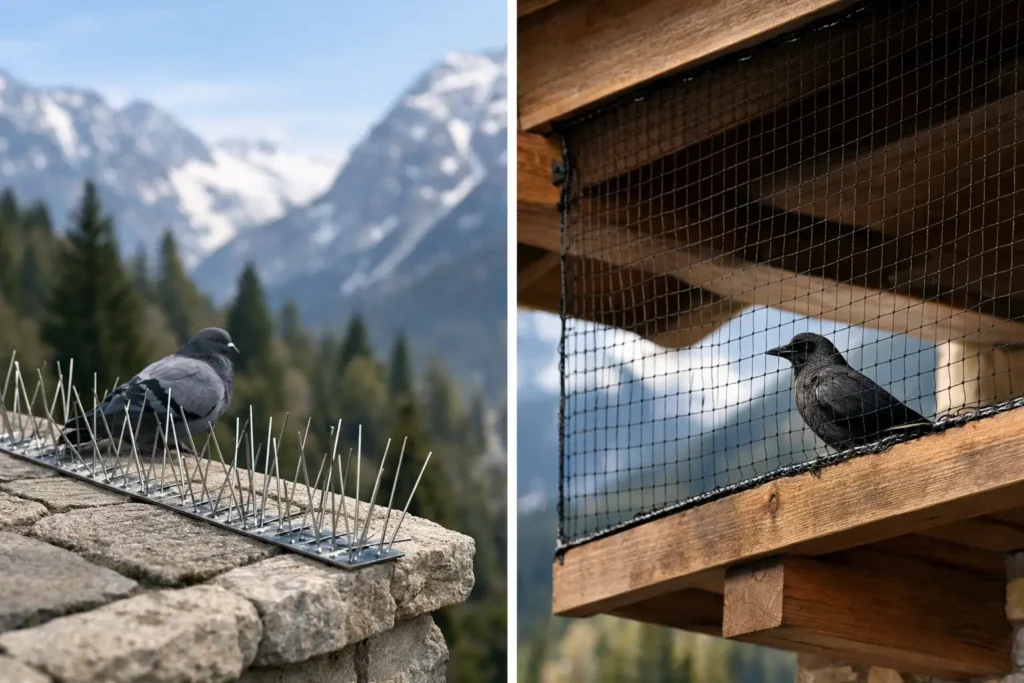
Bird spikes and bird netting solve two different problems. Spikes prevent birds from landing on narrow, exposed surfaces. Netting creates a physical barrier that keeps birds out of a larger opening or protected zone.
Spikes work best on places such as rooflines, parapets, signs, light fixtures, narrow beams, chimney ledges, and air-conditioning units. Properly installed spikes make these landing spots uncomfortable without injuring birds. They are a deterrent, not a trap.
Netting is designed for broader coverage. It can protect eaves, balconies, loading areas, open rafters, solar panel gaps, attic vents, barns, covered patios, and other spaces where birds can enter or build nests. A correctly tensioned, professionally secured net system prevents access rather than simply discouraging a landing.
That distinction matters. If pigeons are lining up along one narrow storefront sign, spikes may be the efficient solution. If sparrows or swallows are repeatedly entering an open porch or warehouse canopy, netting is usually the more dependable choice.
When Bird Spikes Are the Better Choice
Bird spikes are often the practical option when the problem is concentrated on a ledge or edge. They are low-profile, long-lasting when made from quality materials, and easier to blend into many commercial and residential structures than a full netting system.
They are especially useful for pigeons and larger birds that need a clear, flat landing area. A row of properly sized spikes can stop roosting on a roof edge or sign before droppings accumulate below. This can protect entryways, outdoor seating, decks, walkways, and vehicle parking areas.
Spikes also make sense when appearance is a major concern. Clear polycarbonate or stainless-steel systems can be installed with careful attention to the building’s finish. On a mountain cabin or lodge, a clean installation matters. Bird control should not make a well-maintained property look patched together.
However, spikes have limits. They do not close a gap under a roof, stop birds from entering a vent, or protect a large open bay. Small birds may also work around wide-spaced or incorrectly sized spikes. If the installation leaves even a usable landing strip, determined birds can continue to roost.
Spikes are only humane and effective when they are installed correctly. Loose strips, sharp damaged components, or systems installed over active nests can create problems for both birds and property owners. The existing activity should be inspected before any exclusion work begins.
Common spike mistakes
The most common failure is treating spikes as a universal fix. Installing them only on the front edge of a wide ledge can leave enough room for pigeons to stand behind them. Using narrow spikes where larger birds are roosting can have the same result.
Another mistake is installing spikes over old droppings and nesting material. The mess remains a health and sanitation concern, and the odor can continue to attract birds. Cleanup and disinfection should be part of the plan, especially around entrances, attic spaces, and ventilation equipment.
When Bird Netting Is the Better Choice
Bird netting is the stronger option when birds are getting inside, nesting in protected cavities, or occupying a large area. Instead of asking birds to avoid a spot, netting physically denies access to it.
This is particularly valuable for swallows under eaves, sparrows in covered patios, pigeons in warehouse rafters, and birds entering open-sided structures. In wooded areas around Big Bear Lake, Lake Arrowhead, Running Springs, and Crestline, buildings often have deep rooflines, decks, crawlspace openings, and utility spaces that create attractive shelter from weather and predators.
A professionally installed netting system is fitted tightly to the structure, secured around the perimeter, and sized appropriately for the species involved. The goal is to leave no loose edges or gaps that birds can enter, become tangled in, or use as a new nesting point.
Netting can also protect areas where spikes would be impractical, such as under solar panels or across broad loading docks. It offers complete coverage, which is why it is often the preferred long-term exclusion method for recurring nesting activity.
The trade-off is visibility and installation complexity. Netting is more noticeable than spikes in some locations, though dark, properly tensioned netting can be surprisingly discreet from a distance. It also requires careful planning around doors, maintenance access, drainage, and building features. A poorly installed net can sag, collect debris, or fail under snow, wind, and UV exposure.
Netting and active nests
Netting should never be rushed over an active nest. Many bird species, their nests, and eggs are protected by law, and exclusion timing matters. A qualified bird control professional can identify the activity, determine whether young birds are present, and recommend a humane path forward.
Once birds have safely left, exclusion can prevent the same nesting cycle next season. This is far more effective than repeatedly cleaning up after birds return.
Consider the Bird, the Building, and the Season
The best bird control decision starts with an inspection. Pigeons, sparrows, swallows, and woodpeckers do not behave the same way, and a solution that works for one species may be ineffective for another.
Pigeons commonly roost on ledges, signs, rooflines, and protected equipment. Spikes, wire systems, and targeted exclusion can work well depending on the surface. Sparrows can squeeze through small openings and often require detail-oriented screening or netting. Swallows may build mud nests beneath eaves and covered porches, where humane timing and full access exclusion are critical.
Woodpeckers are different still. Spikes and netting may not address the reason they are pecking at siding, trim, or fascia. The work may involve repairing damaged areas, addressing insect activity when present, and using species-appropriate deterrence that protects the building without harming the bird.
Season matters in mountain areas. Snow loads, freezing temperatures, wind, and heavy pine debris can affect exterior installations. A system that looks fine in dry weather may fail after a winter storm if it is not anchored and maintained properly. Property owners should also consider whether ladders, roof access, gutters, or fire-prevention work will be needed later.
Do Not Skip Cleanup and Repair
Whether you choose spikes or netting, bird removal and exclusion are only part of the job. Droppings can create slipping hazards, unpleasant odors, staining, and contamination concerns. Nesting material can clog drains and gutters, interfere with vents, and bring mites or other pests closer to occupied spaces.
A complete solution includes safe cleanup, disinfection when needed, removal of nesting debris, and repair of the access points birds were using. If gaps at eaves, vents, siding, or roof intersections remain open, birds may simply relocate a few feet away.
For commercial properties, this protects more than the building. Clean entrances, sidewalks, and loading areas help protect employees, guests, customers, and the reputation of the business. For vacation rentals and cabins, it can prevent an unpleasant surprise for the next guest or owner arriving for the weekend.
Choosing a Humane, Lasting Solution
Bird control should be specific to the site, not selected from a one-size-fits-all catalog. Spikes are excellent for narrow landing surfaces. Netting is usually better for larger openings, nesting zones, and areas that require complete exclusion. In some cases, the most effective plan uses both: netting to block entry and spikes to remove nearby roosting surfaces.
Outbackzack approaches nuisance bird problems with the same goal property owners share: protect the building while treating wildlife responsibly. That means assessing the species, checking for active nests, cleaning affected areas, and completing exclusion work built for the conditions around your property.
If birds keep returning to the same roofline, porch, sign, or attic opening, do not wait for the mess to become structural damage. A thoughtful inspection can identify the right barrier and help keep your property clean, protected, and ready for the next season.