
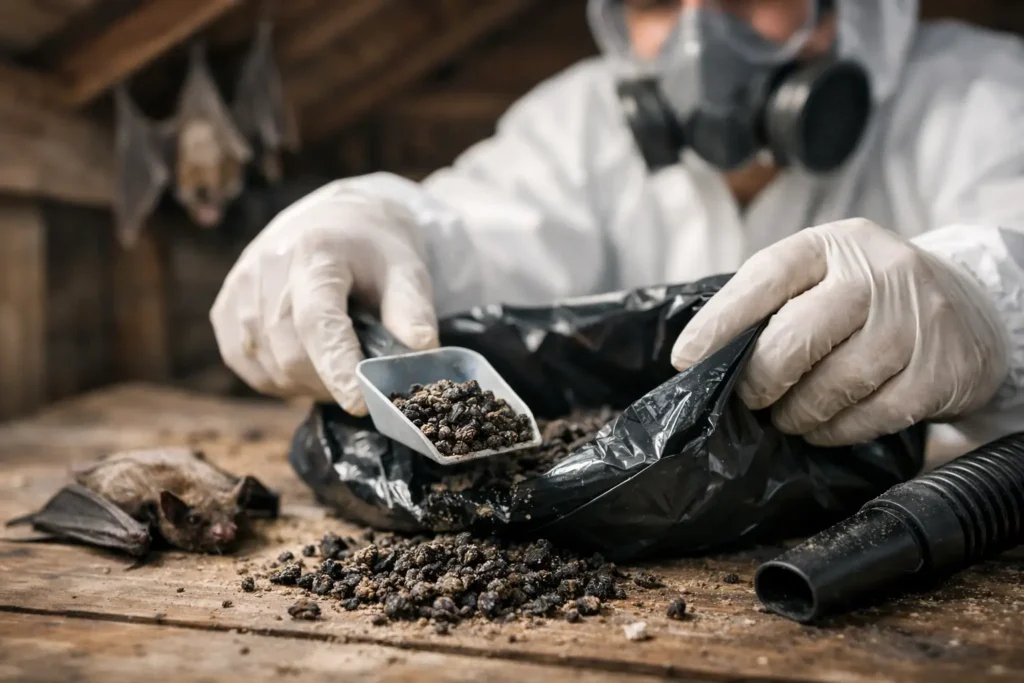
If you found a small pile of dark, crumbly droppings in the attic, garage, or around rooflines, do not sweep it up and move on. When people ask how to remove bat droppings, the real answer starts with safety first. Bat guano is not regular household debris. It can contaminate insulation, wood, vents, and air in ways that put your property and your health at risk.
In mountain communities like Big Bear Lake, Lake Arrowhead, Running Springs, and nearby areas, bats often use attics, gable vents, soffits, and small roof gaps as shelter. That means droppings may build up quietly for weeks or months before anyone notices. By the time you see guano on insulation or window ledges, there may also be urine staining, odor, and an active entry point that still needs attention.
How to Remove Bat Droppings Without Spreading Contamination
The biggest mistake property owners make is dry cleaning the mess. Sweeping, brushing, or vacuuming with a standard household vacuum can push contaminated dust into the air. That is exactly what you want to avoid.
Start by keeping people and pets out of the area. If the droppings are in an attic, crawl space, or enclosed storage area, limit access until the cleanup is done. Open the space only if you can do so without circulating contaminated dust through the rest of the building.
Wear proper protective gear before touching anything. At minimum, that means disposable gloves, eye protection, and a well-fitted respirator rated for fine particles. A basic dust mask is not enough for a heavy guano cleanup. You also want disposable coveralls or clothing that can be washed separately right away.
Before removing droppings, lightly mist the material with a disinfectant or cleaning solution approved for contaminated organic waste. The goal is not to soak the area but to keep dust from becoming airborne. Once the droppings are dampened, use paper towels, disposable rags, or a scoop to collect the material carefully.
Place all waste directly into a heavy-duty trash bag, then seal that bag inside a second bag. If insulation, cardboard, or other porous material is badly contaminated, it may need to be removed and disposed of as well. In many attic jobs, the droppings are only part of the problem. Guano often works its way down into insulation where spot cleaning will not fully solve odor or contamination.
Why Bat Guano Cleanup Needs More Than Surface Cleaning
Bat droppings can carry fungal spores associated with histoplasmosis, a respiratory illness linked to disturbed guano. Risk levels vary based on the amount of droppings, how long they have been there, moisture conditions, and how enclosed the area is. A small amount on an exterior ledge is one thing. A concentrated attic accumulation is another.
There is also the issue of odor and repeat activity. Bats tend to return to safe roosting sites, and lingering waste can leave behind scent cues. If you clean the droppings but leave the entry holes open, the problem is likely to continue. If you close the holes before the bats are properly removed, you can trap animals inside, which creates a much worse situation.
That is why the order matters. Humane bat removal and exclusion should come first, or at least be handled as part of the same plan. Cleanup without exclusion is temporary. Exclusion without cleanup leaves contamination behind.
When a DIY Cleanup May Be Reasonable
If you are dealing with a very small amount of droppings on an exterior surface, such as a porch corner or a window ledge, careful cleanup may be manageable. You still need gloves, respiratory protection, and a damp-clean method. After removal, the area should be disinfected and monitored for fresh droppings.
A minor cleanup makes sense only when the source is already addressed or clearly inactive. If fresh guano keeps appearing, if you hear movement overhead, or if droppings are inside attic insulation, this is no longer a simple wipe-down job.
When to Call a Professional
Professional help is the smarter move when droppings are extensive, the cleanup area is enclosed, or bats may still be roosting in the structure. It is also the right call when contamination has spread into insulation, wall voids, HVAC-adjacent areas, or commercial spaces where sanitation standards matter.
A trained wildlife removal team can identify active entry points, confirm whether bats are still present, perform humane exclusion at the right time, and handle cleanup without making contamination worse. For homes and cabins in wooded mountain settings, that local experience matters. Roof design, seasonal bat activity, and weather all affect how the work should be done.
Step-by-Step Bat Dropping Cleanup
If the contamination is limited and you are proceeding carefully, follow a controlled process.
First, isolate the area and gear up properly. Second, lightly mist the droppings to keep particles down. Third, remove the waste slowly with disposable tools and double-bag it. Fourth, wipe or mop hard surfaces with disinfectant instead of dry scrubbing.
After visible droppings are gone, inspect nearby materials. Look for stained insulation, wood discoloration, greasy rub marks near openings, and urine deposits. If porous materials are contaminated, they often need removal rather than surface treatment.
Finish by disinfecting the area according to product instructions and allowing it to dry fully. Wash hands thoroughly, remove protective clothing carefully, and clean or discard equipment used during the job. Do not carry contaminated items through your living space without bagging them first.
If you used a shop vacuum or household vacuum at any point, there is a good chance contamination spread further than expected. That does not always mean a full remediation project is needed, but it does mean the area deserves a closer inspection.
How to Remove Bat Droppings From Attics and Insulation
Attics are where cleanup gets more complicated. Guano does not just sit on top of insulation. It compresses into it, mixes with dust, and leaves odor behind. In some cases, sections of insulation can be salvaged. In others, replacement is the cleaner and more cost-effective path.
The trade-off usually comes down to depth of contamination. A few isolated droppings on top of intact insulation may allow for targeted removal. Heavy accumulation, urine saturation, and widespread odor usually point toward insulation removal, sanitation, and exclusion repairs.
This is also where homeowners can underestimate the scope. A small stain near a vent may connect to a much larger roosting area behind framing or along the roof deck. If you are seeing repeated droppings in more than one spot, there may be multiple access points or a long-term roost overhead.
Preventing the Problem From Coming Back
Once cleanup is done, prevention becomes the priority. Bats can enter through very small gaps along rooflines, fascia boards, vents, chimneys, and construction joints. Sealing a structure properly takes more than caulk and guesswork.
Any exclusion work has to be humane and timed correctly, especially during maternity season when young bats may not yet be able to fly. Blocking an active roost at the wrong time can separate mothers from pups and leave animals trapped inside the structure. Responsible wildlife control protects the building without harming the animals.
A proper prevention plan usually includes inspection, species-aware timing, one-way exclusion where appropriate, sealing of secondary gaps, and cleanup of contaminated areas. On mountain properties, it is also wise to inspect detached garages, sheds, and vacation cabins that may sit empty for stretches of time.
A Cleaner Property Starts With the Right Response
Bat droppings are not a cosmetic issue. They are a contamination issue, a building maintenance issue, and often a sign that your structure is still vulnerable. If you are figuring out how to remove bat droppings, the safest answer is to treat cleanup and exclusion as one job, not two separate problems.
That is especially true when the droppings are in an attic, above a rental unit, or inside a commercial property where air quality and sanitation affect other people. Outbackzack handles humane wildlife removal with the cleanup, disinfection, and exclusion work needed to protect the property long term.
If the droppings are fresh, the smell is getting stronger, or you are not fully sure where the bats are getting in, trust that instinct. A fast, careful response now is usually much easier than dealing with deeper contamination later.